Latest Temperatures

Current Dew Point

Latest Wind Speeds

Wind Gusts

Top Story

A snowy scene in Jersey City (Hudson County) during the afternoon of February 23rd towards the end of major winter storm.
A snowy scene in Jersey City (Hudson County) during the afternoon of February 23rd towards the end of major winter storm. Around 23" of snow was reported in Jersey City. Photo by The Star-Ledger.

The adage “wash, rinse, repeat” is an appropriate one when reviewing New Jersey’s weather and climate conditions over this past winter. There were multiple snowstorms and cold spells throughout the season, with below-normal precipitation (rain and melted snow/sleet) in each month as the state continues to experience drought conditions that date back almost two years. All this will be covered in a seasonal overview later in this report. First, a recap of conditions in a February that exemplifies what all months experienced this past winter.

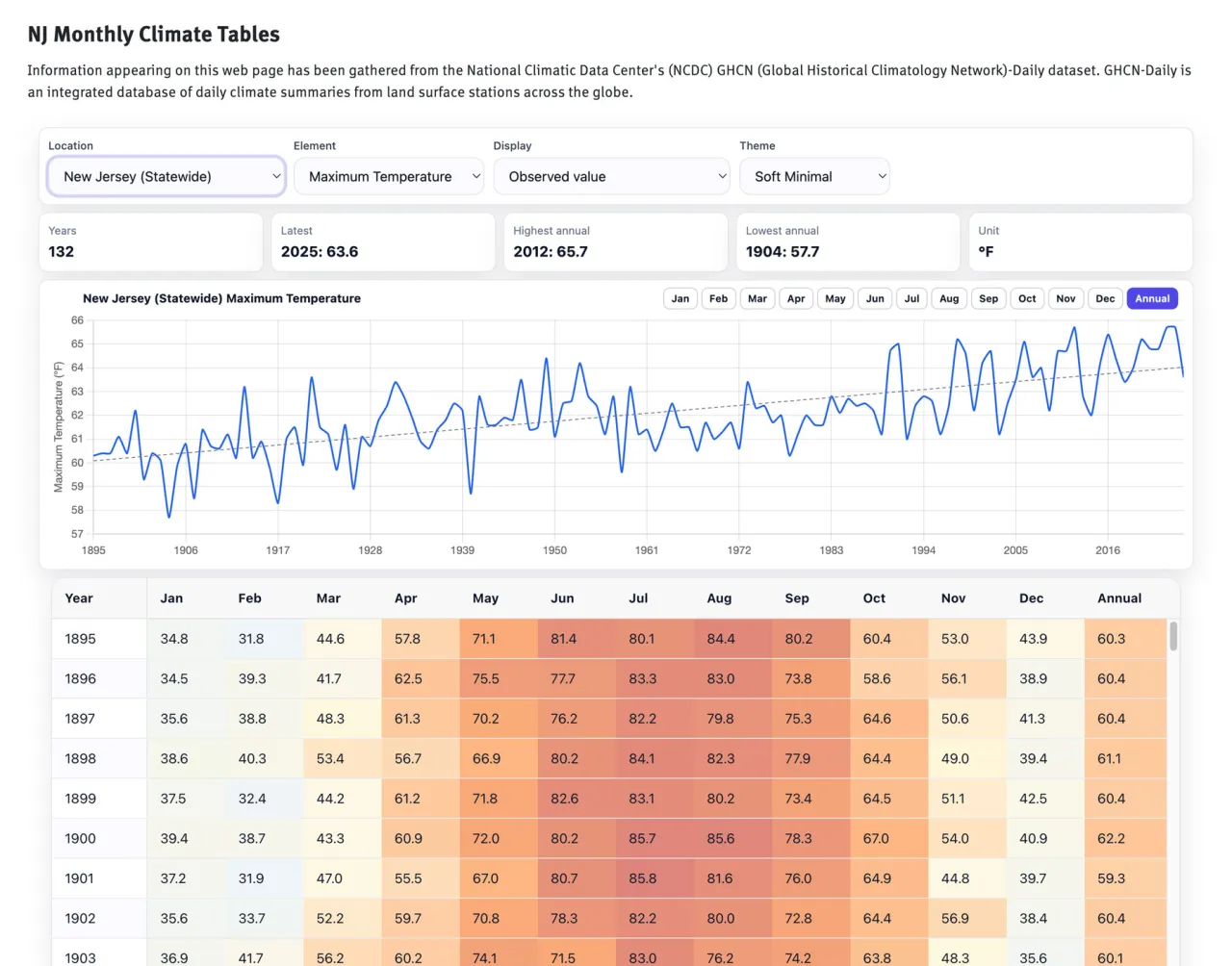
The statewide February temperature averaged 29.6°. This is 4.3° below the 1991–2020 normal and ranks as the 46th coldest February dating back to 1895. The average high temperature of 37.9° is 5.2° below normal and ranks 35th coldest. The average low of 21.4° is 3.2° below normal, ranking 55th coldest.

Precipitation averaged 2.01” across NJ, 0.85” below normal and tied with three other years for the 23rd driest February. This marked 19 of the most recent 22 months with below-normal precipitation. More on this is provided in the winter section of this report.

February snowfall averaged 16.1” across NJ. This is 7.9” above the 1991–2020 normal, ranking as the 18th snowiest since 1895. The northern snow region averaged 15.6” (+5.2”, 29th snowiest), the central region 17.8” (+8.7”, 18th snowiest), and the southern region 15.6” (+8.9”, 12th snowiest). This was the snowiest February since 2021.

Latest Extremes

City, State Temp
Woodbine, NJ 47
Dennis Twp., NJ 47
West Cape May, NJ 47
Fortescue, NJ 46
Vineland, NJ 46
City, State Temp
High Point Monument, NJ 28
Vernon Twp., NJ 33
High Point, NJ 34
Sandyston, NJ 35
Wantage, NJ 35
most current information as of Mar 15 10:10 AM

Latest Conditions & Forecast

New Brunswick, NJ

Rutgers University Meteorology Program

40°F

Wind

7 mph from the E

Wind Gust

13 mph from the E

Partly Sunny
51 °F
Mostly Cloudy then Rain
42 °F
Severe Thunderstorms and Breezy
66 °F
Breezy. Severe Thunderstorms then Showers
32 °F
Chance Showers then Mostly Sunny
41 °F
Mostly Clear
24 °F
Mostly Sunny
41 °F
Mostly Cloudy
29 °F
Partly Sunny
50 °F
Mostly Cloudy
34 °F
Mostly Sunny
55 °F
Mostly Cloudy then Chance Rain
37 °F
Chance Rain
53 °F

Today

Partly sunny, with a high near 51. Southeast wind 5 to 10 mph, with gusts as high as 20 mph.

Tonight

A chance of rain, then rain and possibly a thunderstorm after 2am. Low around 42. East wind around 10 mph, with gusts as high as 20 mph. Chance of precipitation is 100%. New rainfall amounts between a tenth and quarter of an inch, except higher amounts possible in thunderstorms.

Monday

A chance of rain and thunderstorms, then showers and possibly a thunderstorm after 8am. Some of the storms could be severe. High near 66. Breezy, with a south wind 15 to 20 mph, with gusts as high as 35 mph. Chance of precipitation is 100%. New rainfall amounts between a quarter and half of an inch possible.

Monday Night

Showers and possibly a thunderstorm. Some of the storms could be severe. Low around 32. Breezy, with a south wind 15 to 20 mph becoming west after midnight. Winds could gust as high as 35 mph. Chance of precipitation is 100%. New precipitation amounts between a quarter and half of an inch possible.

Tuesday

A chance of showers before 8am. Mostly sunny, with a high near 41. West wind around 15 mph, with gusts as high as 30 mph. Chance of precipitation is 30%. New precipitation amounts of less than a tenth of an inch possible.

Tuesday Night

Mostly clear, with a low around 24.

Wednesday

Mostly sunny, with a high near 41.

Wednesday Night

Mostly cloudy, with a low around 29.

Thursday

Partly sunny, with a high near 50.

Thursday Night

Mostly cloudy, with a low around 34.

Friday

Mostly sunny, with a high near 55.

Friday Night

A chance of rain. Mostly cloudy, with a low around 37. Chance of precipitation is 40%.

Saturday

A chance of rain. Partly sunny, with a high near 53. Chance of precipitation is 40%.

Search by zipcode or city/state for the latest conditions, forecasts, graphs, maps and more nearest to you.

More News

A frozen Navesink River resulting from cold conditions in January allowed for winter recreation, including ice boating by the North Shrewsbury Ice Boat and Yacht Club on February 1st. Photo by Brian Donohue.

Following a cold December and first few days of the month, temperatures rose to above-normal levels through the remainder of the first half of January. Thereafter, a major mid-month atmospheric pattern shift brought Arctic air roaring into the region, and with it several snow events and one of the more persistent cold episodes in recent years lasting through the end of the month. The first 15 days of January averaged 13° milder than the final 16 days. All told, the statewide January average temperature of 28.0° was 3.7° below the 1991–2020 normal. It ranked as the 42nd coldest since NJ...

A mini snowman built in a Clark Township (Union County) front lawn following the December 13th-14th snowfall. Photo courtesy of Dan Zarrow.

The winter season of 2025/2026 took no time to display its wares this past month; it was quick out of the gate. Time will tell whether this was a sign of what lies ahead for the rest of the season. For now, enough cold, wind, and snow arrived this month to remind all that winter in NJ can be a force to be reckoned with. Statewide, the average December temperature of 31.8° was 4.8° below the 1991–2020 normal and ranked as the 43rd coldest since records commenced in 1895. It was New Jersey’s coldest December since 2010 (ranked 29th) and third coldest since 2000 (ranked 18th). The average...

A dry Oak Ridge Reservoir along the Sussex/Morris County border on September 15th when the area was classified in "Moderate Drought" category. Photo courtesy of Alex Burdi.

For the 17th consecutive year, we in the state climate office have evaluated the myriad daily, monthly, and annual observations gathered across New Jersey during the course of the year to choose what we feel were the most significant and impactful 10 weather and climate events of 2025. More about each event can be found in the monthly narratives posted on our website. You might be tempted to rearrange the rankings, particularly as some of the events on the list may have affected you more than others ranked higher. Or perhaps you best recall one that didn't make the list. That's the...

More News

The Heat Goes On: November & Fall 2020 Recaps

December 7, 2020 - 8:43pm -- Dave Robinson

CoCoRaHS rain gauge

November 2020 enters the New Jersey climate record book as the third warmest (tied with 2009). The statewide mean of 49.2° was 4.0° above the 1981–2010 normal. This month joins six Novembers from this century among the seven warmest of the past 126 years. Six of the past 12 months have ranked in the top nine for warmth. Of the first 11 months of 2020, only April and May averaged below normal. The average temperature for the first 11 months is 57.1°. This is 2.7° above normal and ranks as the second warmest such interval. Only 2012 was warmer, with both years likely to retain this ranking for the calendar year unless an extremely cold or warm December occurs, which, as this report is written, appears unlikely.

Statewide precipitation total for November was 3.91”. This was 0.30” above the 1981–2010 normal and ranks as the 43rd wettest of the past 126 years. The southern half of the state was on the wetter side of normal while the north on the dry side. This was seen in the divisional numbers that had the south come in with 4.43”, which is 0.98” above average 33rd wettest, while the north averaged 3.09”, which is 0.77” below average and ranks 78th wettest (49th driest).

A Transition Month for Sure: October 2020 Recap

November 5, 2020 - 1:52pm -- Dave Robinson

Dew spider web on the morning of October 14th in Sussex County

As the warmth of summer transitions to the cold of winter, New Jersey weather conditions can vary markedly from week to week. Such was the case during October 2020, with abundant precipitation occurring from the remnants of two hurricanes, an episode of measurable snow in the north, several weeks of quite dry conditions, a number of comfortably warm days, and the first frost and freeze of the season for many locations. Put this all together and October proved to be milder and wetter than normal. The statewide monthly average temperature of 57.2° was 2.7° above the 1981–2010 mean. This ranks as the 18th mildest (tied with 1963 and 1931) over the 126 years extending back to 1895. Southern areas were warmer than northern ones in terms of actual temperature and departure from normal. The 58.8° average in the south was 3.2° above normal and ranked 15th warmest. The north averaged 54.4°, which was 2.0° on the plus side and ranking 27th mildest.

It took a wet final week of the month to push precipitation totals to the plus side of normal. The 5.15” statewide monthly average was 1.26” above normal and ranked as the 24th wettest on record. Somewhat like temperatures, there was north-south disparity. The south averaged 5.36”, which is 1.73” above normal and ranks 20th wettest. The north averaged 4.64”, which is 0.33” above normal and ranks 36th wettest. Dry conditions prevailed, most notably in the northwest, with coastal reaches wettest. Snow fell in the north on the 30th and will be discussed below.

Up and Down But in the End Quite Average: September 2020 Recap

October 6, 2020 - 1:08pm -- Dave Robinson

Smokey sunset on September 15th

September 2020 was a month of widely-varying temperatures, several episodes of heavy precipitation, and an extended dry spell. Put it all together and conditions averaged quite close to normal. The statewide monthly average temperature of 66.8° was 1.0° above the 1981–2010 mean. While it was the seventh month of 2020 to average above normal, it was the first of these not to rank in the top 10 for warmth. Rather, it ranked 33rd warmest of the past 126 Septembers. Divisional departures from normal ranged from +0.7° in the north to +1.5° along the coast. The statewide average maximum temperature was 76.6°, which is 0.3° above normal and ranks 47th warmest. The average minimum of 56.9° was 1.6° on the warm side and ranked 24th mildest. High temperatures were likely reduced by several degrees during a mid-month period when a veil of smoke from western US forest fires blanketed the sky at an altitude of about 15,000 feet when skies otherwise would have been blue, especially on the 15th–16th. It is uncertain if this kept minimum temperatures somewhat warmer than they would otherwise have been. A cold front moved through from the northwest on the 18th, clearing the skies and sending temperatures plummeting. What followed was a four-day spell of temperatures that were well below average, including four nights with below-freezing temperatures at three to four Rutgers NJ Weather Network sites. While freezes resulting from cold air draining into valleys in some northern locations are not unprecedented before the end of astronomical summer, it is highly unusual for the cold to persist over four consecutive nights.

The Beat Goes On: August 2020 & Summer Recaps

September 7, 2020 - 9:50pm -- Dave Robinson

Sunset photo

August joined the chorus of much warmer-than-normal months experienced throughout most of 2020 to date across the Garden State. Six of the eight months have ranked among the top 10 warmest for the 126 years beginning in 1895. Only April and May are outliers and, in fact, each of them had below-average temperatures. With a mean of 75.5°, August tied with 2001 and 1955 as the 6th warmest. This is 2.5° above the 1981–2010 mean. Eleven of the warmest 17 Augusts have occurred since 2001. The mean maximum of 84.8° tied for 19th warmest at 1.5° above normal, while the mean minimum of 66.1° was 3.4° above normal and ranked 4th warmest.

Statewide precipitation averaged 6.04”. This is 1.94” above normal and ranks as the 26th wettest August on record. Above-average totals occurred in northern (6.02”), southern (6.10”), and coastal (5.50”) climate divisions. The southern division (Mercer-Middlesex-Monmouth counties and south, except a narrow coastal division) saw a range from the driest area in Monmouth and parts of Mercer counties and a very wet area in Salem and Gloucester counties.

Record Heat: July 2020 Recap

August 8, 2020 - 7:03pm -- Dave Robinson

Upper Township hail on July 1st

July 2020 was the hottest month on record for the Garden State since records commenced in 1895. The statewide average temperature of 78.8° was 4.2° above the 1981–2010 normal. This reading surpasses by 0.4° the previous record held jointly by 1955, 1999, and 2011. The next ten warmest months have occurred in July, with the warmest August averaging 76.8° in 2016, which is tied with July 1994 as the 11th warmest month on record. The average 88.9° maximum this past July was 5th warmest, the warmest occurring in 1999. The average minimum of 68.8° ranked second, trailing just 2013. The southern and coastal climate divisions had their warmest month on record while the northern division ranked second.

The statewide average precipitation this July was 6.79”. This is 2.22” above the 1981–2010 normal and ranks as the 15th wettest July on record. Looking at the state in quarters from north to south, the northernmost was driest, particularly the northwest. Next came a wet sector, followed by a more average one, with the southernmost quarter the wettest. Few locations received less than 4 inches, while scattered totals of more than 10 inches were found in the two wettest quarters.

Summer Arrives: June Recap (with a brief look at the first half of 2020)

July 7, 2020 - 4:44pm -- Dave Robinson

Tree blown over from June 3rd derecho

The statewide average precipitation this June was 3.10”. This is 0.91” below the 1981–2010 average and ranks as the 43rd driest of the past 126 Junes. As is typical during the warm season, where the bulk of the rainfall is provided by showers and thunderstorms, totals varied widely from location to location, even at times in close proximity to one another. Monmouth and northern Ocean counties saw the most, totaling over 5.00” in spots, with a secondary maximum in Gloucester County. The Highlands, portions of central NJ, and southern Ocean and Cape May counties saw as little as 1.00–2.00”.

The statewide average temperature of 71.6° was 1.8° above the 1981–2010 normal. This ranks as the 10th warmest, joining four other years this century in the top 10, while being the warmest since 2011.

Endless Spring: May and Spring 2020 Recaps

June 7, 2020 - 6:34pm -- Dave Robinson

In recent years, many a comment has been heard that New Jersey just does not have a spring season any more. We go right from winter to summer weather, people say. The same cannot be said for spring 2020. A seasonal summary follows at the end of this report and the individual March and April reports can be found on the state climate office website. To begin here, the talk will be of May, a month that produced both less rain and cooler temperatures than normal and included an unusual appearance of snow.

The statewide average temperature of 58.9° was 1.7° below the 1981–2010 normal. This ranked as the 40th coolest May since records commenced in 1895. April and May marked the first time since December 2017–January 2018 that consecutive months had below-average temperatures. Statewide, May precipitation averaged 2.50”. This was 1.49” below normal and ranked as the 29th driest on record.

Blown Away: April 2020 Recap

May 5, 2020 - 10:23pm -- Dave Robinson

Gas station canopy collapse

If you have a sense that April was unusually windy, you are certainly not alone. While long-term wind observations are few across the Garden State and those available suffer from inconsistencies in instrumentation and location, seat-of-the-pants judgment tells us that plenty of air raced crossed the state throughout the month. In fact, the wind gusted to 40 mph or higher at one or more NJWxNet station on 12 days. Of those, seven had gusts from 50–59 mph and an impressive four gusted over 60 mph. The highest network gust of 76 mph occurred at Sea Girt (Monmouth County) on the 21st. There were also reports from other seemingly reliable stations of gusts as high as 82 mph at Island Beach State Park (Ocean) on the 13th.

April precipitation achieved a statewide average of 3.92”. This is 0.07” below the 1981–2010 mean, but given the skewness of the distribution of April rainfall over the past 126 years, it ranks as the 45th wettest. Despite Morris County stations having the highest monthly totals, overall, the north part of the state was driest. The mean of 3.66” was 0.54” below normal and is the 59th driest (68th wettest). The south averaged 4.07”, which is 0.21” above normal and is 40th wettest. The narrow coastal region averaged 4.16”, which is 0.33” above normal and ranks 39th wettest.

A Dud: 2019/2020 Snow Season Recap

April 28, 2020 - 6:14pm -- Dave Robinson

2019/20 season snowfall map

As we gradually transition into warmer spring temperatures, it’s a good time to recap what was a disappointing season for snow lovers, along with snowplow drivers, auto body repair people, and others who profit from snowy winters.

Seasonal snow totaled 4.7” averaged across the state. This is 19.2” below the 1981–2010 average and, looking back from the 1896/96 to 2018/19 snow seasons, is 21.4” below average. This ranks as the third least-snowy winter snow season, only behind the winters of 1972/73 and 1918/19.

Spring Ahead: March 2020 Recap

April 7, 2020 - 11:40am -- Dave Robinson

March 2020 was the 6th mildest in New Jersey dating back to 1895. Combined with mild rankings of 9th in January and 4th in February, 2020 has started off as the 2nd mildest on record at 5.8° above the 1981–2010 average. The 40.8° average only falls behind 2012’s 41.4°. Six of the ten mildest January–March intervals in the past 126 years have occurred since 2002.

March averaged 46.3° across NJ, which is 5.5° above average. The average maximum of 56.2° (+5.4°) ranked 7th mildest and the minimum of 36.4° (+5.6°) 2nd mildest. Anomalies were +5.8° in both the southern (47.9°) and coastal (47.7°) divisions, ranking 6th and 4th mildest, respectively, and +5.0° in the north (43.7°), ranking 9th mildest. As a result of the premature warmth, vegetation green up across the state was at least two weeks earlier than normal.

Pages

Subscribe to Front page feed