
News

Emerging from Dormancy: March 2026 Recap
April 7, 2026 - 5:42pm -- Dave Robinson

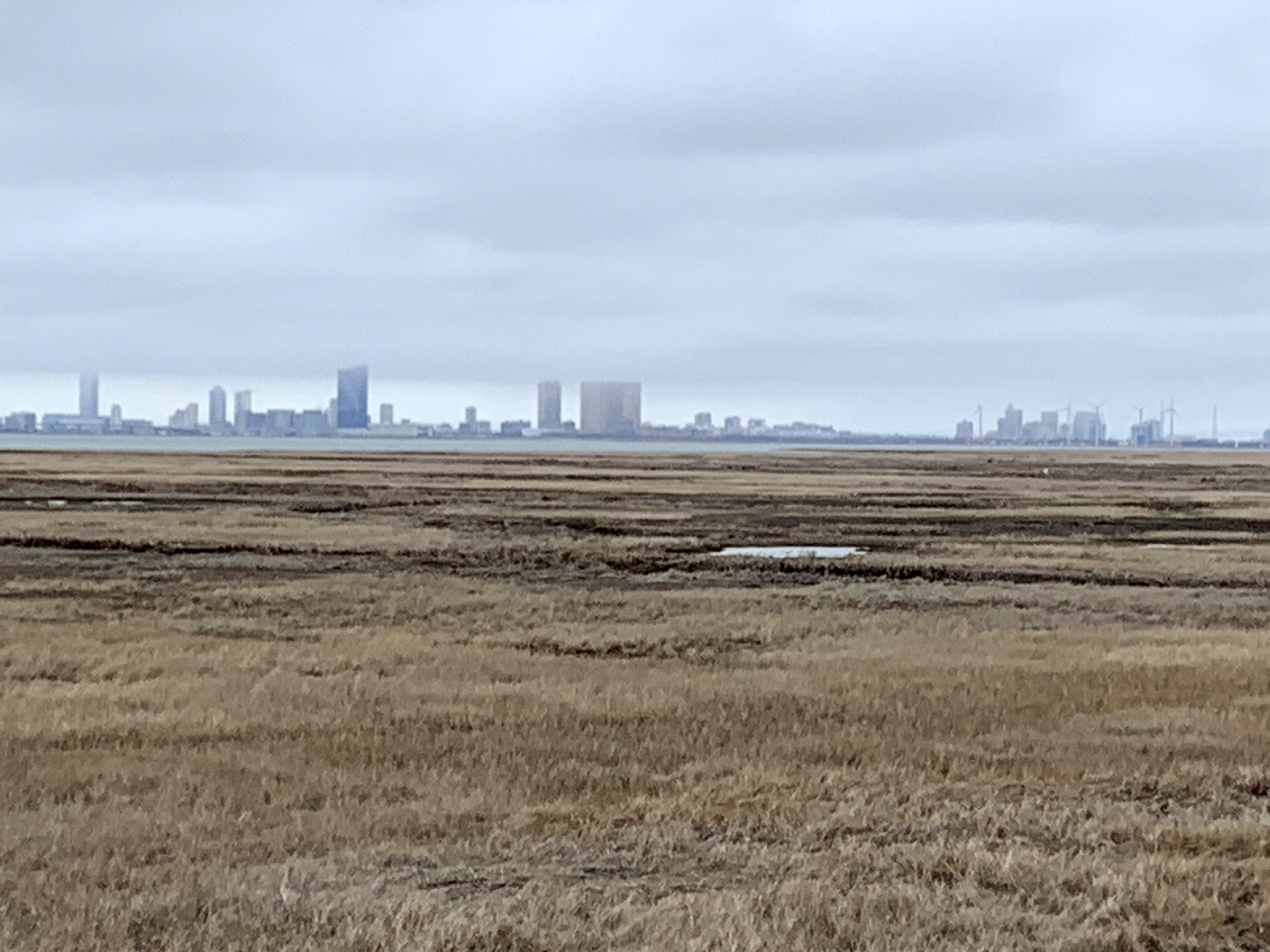
Low clouds hover over Atlantic City as seen from the Forsythe Wildlife Refuge in Galloway Township (Atlantic County) on March 6th. Photo by Dave Robinson.

As is common as winter transitions into spring, this weather/climate shift came in fits and starts this March. Included were some rapid thermal flips, occasional powerful winds, and enough rain in the north to ease drought concerns but well below-normal rain in the south, a region that during winter had been leading the way with beneficial precipitation. The only thing mostly missing, for the third consecutive March, was snowfall, as the persistent snow and ice cover of recent months quickly melted.

With a statewide ranking of 12th warmest, March 2026 is the eighth over the past 26 years to rank in the top 15 with records dating back to 1895. The 45.1° statewide average is 4.1° above the 1991–2020 normal. The average high of 55.9° is 5.0° above normal and ranks 11th mildest. The average low of 34.3° is 3.1° above normal and ranks 14th mildest. Regionally, the northern division averaged 42.9° (+4.1°, 12th mildest), the southern division 46.6° (+4.2°, 12th mildest), and the coastal division 45.9° (+3.7°, 12th mildest).

Statewide, March precipitation averaged 3.28”. This is 0.92” below normal, ranking as the 47th driest on record. The north came in at 4.78” (+0.77”, 30th wettest/103rd driest), the south 2.37” (-1.95”, 21st driest), and the coast 2.24” (-2.18”, 16th driest). The overall below-normal NJ precipitation pattern dates to May 2024, with 20 of the past 23 months below normal. Thus, NJ remained in a NJ Department of Environmental Protection Drought Warning and all of the state was in a stage of moderate drought or abnormal dryness according to the US Drought Monitor at month’s end.
Wash, Rinse, Repeat: February 2026 & Winter 2025/2026 Recaps

March 6, 2026 - 4:50pm -- Dave Robinson

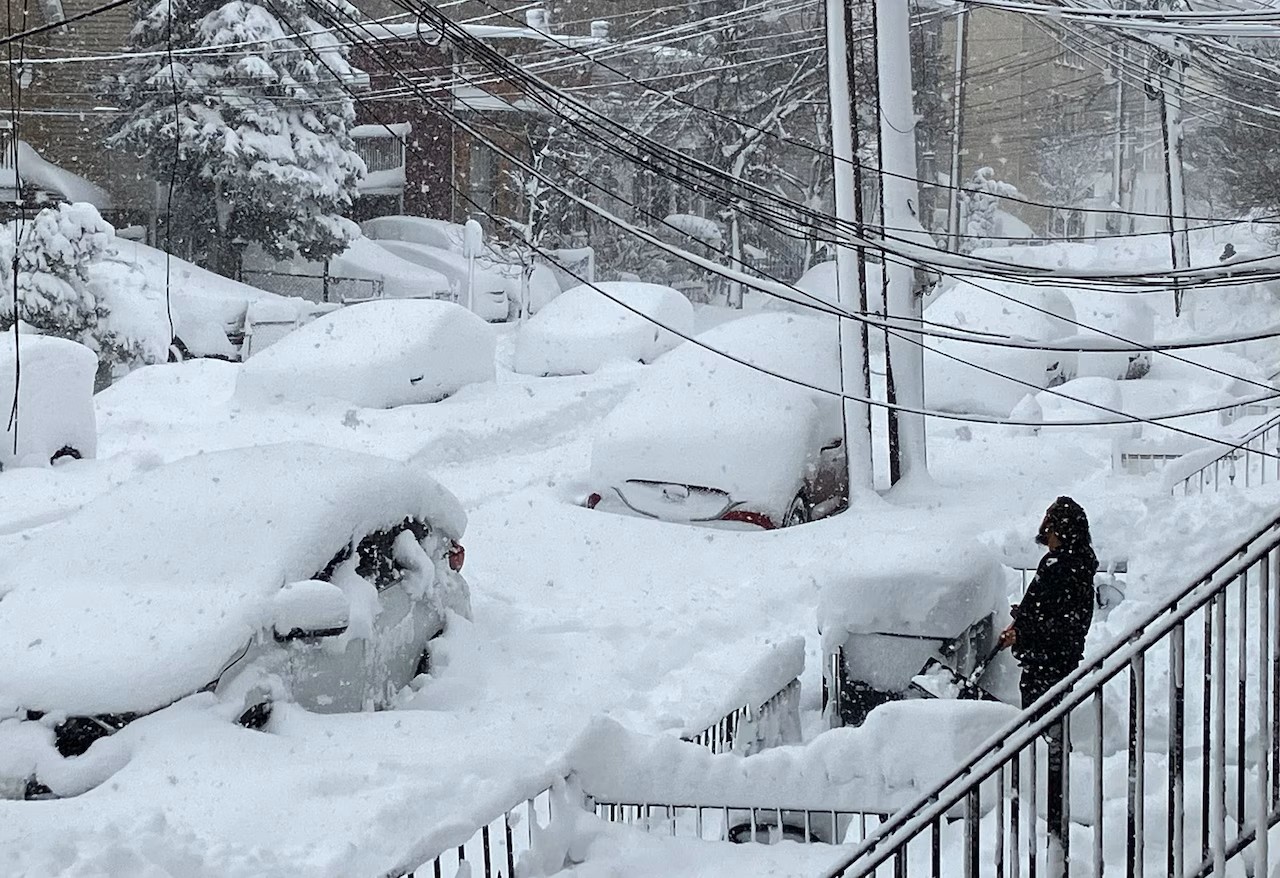
A snowy scene in Jersey City (Hudson County) during the afternoon of February 23rd towards the end of major winter storm.

The adage “wash, rinse, repeat” is an appropriate one when reviewing New Jersey’s weather and climate conditions over this past winter. There were multiple snowstorms and cold spells throughout the season, with below-normal precipitation (rain and melted snow/sleet) in each month as the state continues to experience drought conditions that date back almost two years. All this will be covered in a seasonal overview later in this report. First, a recap of conditions in a February that exemplifies what all months experienced this past winter.

The statewide February temperature averaged 29.6°. This is 4.3° below the 1991–2020 normal and ranks as the 46th coldest February dating back to 1895. The average high temperature of 37.9° is 5.2° below normal and ranks 35th coldest. The average low of 21.4° is 3.2° below normal, ranking 55th coldest.

Precipitation averaged 2.01” across NJ, 0.85” below normal and tied with three other years for the 23rd driest February. This marked 19 of the most recent 22 months with below-normal precipitation. More on this is provided in the winter section of this report.

February snowfall averaged 16.1” across NJ. This is 7.9” above the 1991–2020 normal, ranking as the 18th snowiest since 1895. The northern snow region averaged 15.6” (+5.2”, 29th snowiest), the central region 17.8” (+8.7”, 18th snowiest), and the southern region 15.6” (+8.9”, 12th snowiest). This was the snowiest February since 2021.

Half a Roar: January 2026 Report

February 6, 2026 - 3:01pm -- Dave Robinson

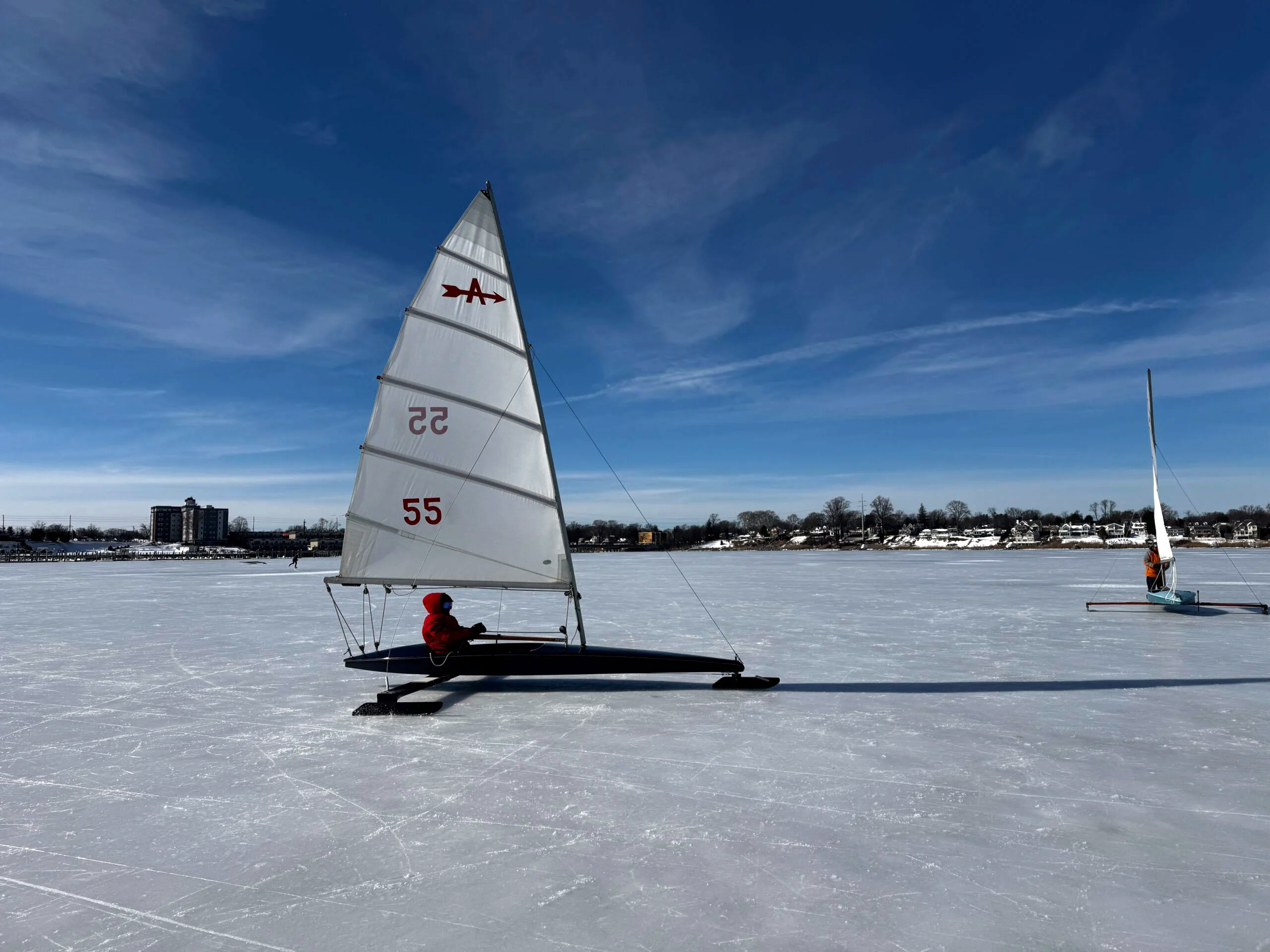
A frozen Navesink River resulting from cold conditions in January allowed for winter recreation, including ice boating by the North Shrewsbury Ice Boat and Yacht Club on February 1st. Photo by Brian Donohue.

Following a cold December and first few days of the month, temperatures rose to above-normal levels through the remainder of the first half of January. Thereafter, a major mid-month atmospheric pattern shift brought Arctic air roaring into the region, and with it several snow events and one of the more persistent cold episodes in recent years lasting through the end of the month.

The first 15 days of January averaged 13° milder than the final 16 days. All told, the statewide January average temperature of 28.0° was 3.7° below the 1991–2020 normal. It ranked as the 42nd coldest since NJ records commenced in 1895 and was the coldest since 2014 and 5th coldest this century. The average high was 36.4°, 3.9° below normal and the 45th coldest, while the average low of 19.6° was 3.6° below normal, ranking 44th coldest.

Despite a soaking rain event early in the month and an impactful late-month winter storm, the monthly statewide precipitation average (rain and melted snow/ice) was below normal at 2.67”. This was 0.82” below average and ranked as the 42nd driest. January snowfall averaged 14.3” across NJ. This was 7.1” above normal and ranks as the 17th snowiest of the past 132 years.

Quickly Out of the Gate/Drought Persists: December/2025 Annual Report

January 7, 2026 - 7:47pm -- Dave Robinson

A mini snowman built in a Clark Township (Union County) front lawn following the December 13th-14th snowfall. Photo courtesy of Dan Zarrow.

The winter season of 2025/2026 took no time to display its wares this past month; it was quick out of the gate. Time will tell whether this was a sign of what lies ahead for the rest of the season. For now, enough cold, wind, and snow arrived this month to remind all that winter in NJ can be a force to be reckoned with.

Statewide, the average December temperature of 31.8° was 4.8° below the 1991–2020 normal and ranked as the 43rd coldest since records commenced in 1895. It was New Jersey’s coldest December since 2010 (ranked 29th) and third coldest since 2000 (ranked 18th). The average maximum of 40.5° was 4.5° below normal and ranked 49th coldest. The average minimum of 23.2° was 5.0° below normal and ranked 37th coldest. The northern climate division averaged 28.9° (-5.2°, 40th coldest), the southern division 33.5° (-4.6°, 46th coldest), and the coastal division 34.6° (-4.5°, 45th coldest).

Precipitation (rain and melted snow) amounted to a statewide average of 3.13”. This was 1.14” below normal and ranks as the 55th driest December. Totals were rather evenly distributed across the state. This was the 10th month of 2025 with below normal precipitation. The north averaged 2.86” (-1.39”, 42nd driest), south 3.31” (-0.97”, 58th driest), and coast 3.22” (-1.14”, 56th driest). On December 5th, the NJ Department of Environmental Protection (NJDEP) declared a transition from a statewide Drought Watch to a Drought Warning, indicative of the persistent precipitation deficits.

ONJSC's Top 10 NJ Weather and Climate Events of 2025

January 1, 2026 - 4:00pm -- Dave Robinson

A dry Oak Ridge Reservoir along the Sussex/Morris County border on September 15th when the area was classified in "Moderate Drought" category. Photo courtesy of Alex Burdi

For the 17th consecutive year, we in the state climate office have evaluated the myriad daily, monthly, and annual observations gathered across New Jersey during the course of the year to choose what we feel were the most significant and impactful 10 weather and climate events of 2025. More about each event can be found in the monthly narratives posted on our website. You might be tempted to rearrange the rankings, particularly as some of the events on the list may have affected you more than others ranked higher. Or perhaps you best recall one that didn't make the list. That's the enjoyment and frustration of lists! Unless stated otherwise, statewide values are based on an average of several dozen stations. The period of record for monthly, seasonal, and annual departures is 1991–2020; while for extremes and rankings it is from 1895–present. Observations are mainly drawn from National Weather Service Cooperative Observing Program stations, Rutgers NJ Weather Network (NJWxNet) stations, and NJ Community Collaborative Rain, Hail, and Snow Network (CoCoRaHS) locations.

Is That All There Was?: November and Fall 2025 Recaps

December 8, 2025 - 6:14pm -- Dave Robinson

Sunfish Pond along the Appalachian Trail in Worthington State Forest (Hardwick Township, Warren County) on November 6th.

Never doubt that this author can find something interesting associated with the weather and climate of any month or season. However, truth be told, sometimes what transpires does not rise to the level of exceptional interest among those not infected with the weather bug. For the most part, this report’s title holds true for this November and fall. Certainly, there was many a gusty day this past month. Also, drought concerns failed to abate in a season where each month saw below normal statewide precipitation, making it 13 of the past 15 months with deficient precipitation. However, despite low precipitation totals, there were many dull, cloudy November days, New Jersey’s fall (fortunately) escaped any tropical storms, and just one notable early-season coastal storm occurred, albeit generating coastal flooding with associated damage. Next is a discussion of November conditions, followed by a brief recap of fall precipitation and temperature statistics.

November precipitation, virtually all in the form of rain, averaged 1.88” across NJ. This was 1.48” below the 1991–2020 mean and ranked 23rd driest of the past 131 years. The northern climate division (Hunterdon/Somerset/Union and northward) averaged 1.87” (-1.60”, 22nd driest), the southern division (Mercer/Middlesex/Monmouth southward, except east of the Garden State Parkway) 1.91” (-1.38”, 33rd driest), and the coastal division (east of the Parkway) 1.70” (-1.64”, 26th driest). The far northwest and far south were driest. Wetter totals, though still below average, were found along the Turnpike corridor and in portions of Central NJ.

Transition Indeed: October 2025 Recap

November 5, 2025 - 12:42pm -- Dave Robinson

Tidal flooding in North Wildwood (Cape May County) on October 12th caused by a stalled nor'easter just off the coast. Photo by Greg Graham.

With the warm end of September, followed by four days in the 80°s early in October, one might have wondered when fall weather was going to arrive in New Jersey. By now, we know that by mid-month a transition to cooler weather arrived. Meanwhile, there were two notable coastal nor’easters, indicative of a transition to a cool season weather regime. Unfortunately, each resulted in notable coastal flooding and beach erosion. Yet most of NJ remains modestly to moderately dry.

Ultimately, with all the ups and downs of temperature and precipitation during this transitional month, the state averaged a bit milder and drier than normal. The statewide average temperature of 56.2° was 0.8° above the 1991–2020 mean and ranked as the 33rd mildest of the past 131 Octobers. The average high of 66.5° was 0.7° above normal, ranking 45th mildest. The average low of 45.9° was 1.0° above normal, ranking 29th mildest. The northern climate division averaged 54.6° (+1.3°, 27th mildest), the southern division 57.0° (+0.5°, 41st mildest), and the coastal division 58.7° (+1.1°, 28th mildest).

October precipitation averaged 3.79”, which was 0.40” below normal. Due to the skewed nature of the monthly precipitation time series, this ranked as the 57th wettest/75th driest. The north averaged 3.71” (-0.74”, 64th wettest/68th driest), the south 3.80” (-0.23”, 49th wettest/83rd driest), and the coast 4.23” (+0.14”, 36th wettest/96th driest). The divisional averages did not tell the story of the precipitation distribution all that well. Rather, best said that the western half of NJ was on the drier side and the east wetter.

Holding On: September 2025 Recap

October 6, 2025 - 11:22am -- Dave Robinson

A dry Oak Ridge Reservoir along the Sussex/Morris County border on September 15th. This part of northern NJ remains in the "Moderate Drought" category at month's end. Photo courtesy of Alex Burdi.

“Holding On.” Perhaps you’re a bit perplexed attempting to interpret the title of this month’s report. Something with respect to temperature? Certainly, the warm season hardly relinquished its grip on the Garden State during the past month. September temperatures averaged above normal, mainly due to the second half of the month being warmer than the first half. Normally the second half averages approximately 5.0°–5.5° cooler than the first, however this year’s second half was 1.0°–1.5° milder than the first half in the north and about 2° milder in the south. Something regarding precipitation? It was the second consecutive month with below-normal statewide precipitation, with eleven of the past thirteen months having below-normal precipitation. The month ended with most of north Jersey categorized on the US Drought Monitor as being Abnormally Dry or in Moderate Drought, and October 1st found the NJ Department of Environmental Protection declaring a Drought Watch across the entire state. Despite this, the state has not slid into a significant drought situation as is currently found in New England. Water resources are holding on but certainly are more vulnerable than anyone would like.

Statewide, the September temperature averaged 68.1°. This was 1.2° above the 1991–2020 normal and ranked as the 16th warmest September since records commenced in 1895. Ten of the twenty warmest Septembers have occurred since 2010. The average high was 78.0°, which is 0.8° above normal and ranks as the 26th warmest on record. The average low was 58.2°, which is 1.6° above normal and ranks as 12th warmest. The northern climate division averaged 66.9° (+2.0°, 8th warmest), the southern division 68.8° (+0.7°, 25th warmest), and the coastal division 69.0° (+0.3°, 28th warmest).

Flip Flopping: August and Summer 2025 Recaps

September 5, 2025 - 10:34pm -- Dave Robinson

Significant beach erosion in Beach Haven (Ocean County) following days of strong wave action caused by Hurricane Erin. Photo by Beach Haven Mayor Colleen Lambert.

August and summer 2025 weather conditions vacillated between heat with plenty of humidity to cool and quite pleasant. In the mix were also some local extreme storms with damaging impacts, while there were also some extended dry intervals. Flip flopping seems to appropriately sum up this Jersey summer in the weather department. This report first focuses on August conditions across the Garden State, then provides a summary of summer (June–August) conditions.

New Jersey averaged 2.16” for August. This is 2.41” below normal, which ranks 13th driest dating back to 1895. The northern climate division (Hunterdon-Somerset-Union and all counties to their north) averaged 2.22” (-2.34”, 14th driest). The southern division (Mercer-Middlesex-Monmouth and all but immediate coastal areas to the south) came in at 2.14” (-2.43”, 14th driest). The coastal division averaged 2.11” (-2.49”, 16th driest).

August began with a stretch of cooler-than-normal conditions, then warmed for a little over a week before again dropping below normal at month’s end. Overall, the 70.7° statewide monthly average was 2.9° below normal, ranking 37th coolest of the past 131 years. It was the coolest August since 1994. The average high of 81.4° was 2.4° below normal and ranks 39th coolest. The average low of 59.9° was 3.4° below normal and ranks 35th coolest. The northern climate division averaged 69.5° (-2.4°, 45th coolest), the southern 71.4° (-3.2°, 31st coolest), and the coastal 71.5° (-3.2°, 33rd coolest).

Danger Lurks: July 2025 Recap

August 6, 2025 - 4:47pm -- Dave Robinson

Debris and rubble in the aftermath of flash flooding that occurred on July 14th in North Plainfield (Somerset County).

Tragically, this July demonstrated how weather danger lurks across the Garden State during summer months. July thunderstorm winds felled trees that resulted in three fatalities, lightning strikes killed two and injured others, and flash flooding took two lives and put countless others in perilous situations. No doubt, the often-relentless heat and humidity led to medical issues for those most vulnerable, be they old, young, infirmed, employed outdoors, or living in stifling locations devoid of air conditioning.

Temperature-wise, the July statewide average temperature of 78.1° was 2.7° above the 1991–2020 mean and ranked as the 6th warmest since records commenced in 1895. The average high of 87.7° was 2.0° above normal, ranking 12th warmest, while the average low of 68.5° was 3.4° above normal, ranking 3rd warmest. Eight of the ten warmest Julys have occurred since 2010 and twelve of fifteen since 1999. Only three Julys in the past 25 years have averaged below the 1991–2010 normal. The June–July average of 75.0° is the 5th warmest, only exceeded by 76.1° in 2010, 75.6° in 2024, and 75.2° in both 2020 and 2011.

The 5.44” statewide average July precipitation was 0.73” above normal, ranking 42nd wettest of the past 131 Julys. As is often seen during summer months, totals varied markedly over rather short distances, seen this month in both the north and south. Overall, the north averaged 4.62” (-0.10”, 64th wettest/68th driest), south 5.93” (+1.19”, 26th wettest), and coast 6.08” (+1.70”, 20th wettest).

Pages

Subscribe to RSS - News